Wednesday, August 26, 2015

Remeber, big words are scary.

Science literacy is important to all of us.  I start this post by way of anecdote, as observed by myself.  I was at work, and a coworker of mine happened to notice a container someone else had packed a lunch in. On the front of the package was the basic nutritional information, in those handy bubbles everyone now seems to be using.  This information happened to indicate that there was, let's say, 460mg of sodium per serving (or however it's presented).  Coworker says that this seems like a lot of sodium.  I point out that it's only about half a gram, and the coworker doesn't know what that means, because he doesn't understand metric.  I point out that it's roughly one percent of an ounce, something along those lines.  He still thinks it's a lot of salt for a lunch meat product to contain. I ask him if he realizes that's only about a gram of salt, give or take, but by this point I've already lost him.  I ask him further if he knows what's in table salt, or what salt is, and he has no clue.

Now, to be fair, he's starting his fifth year of college, majoring in business administration.  Salt is probably not something he needs to think about most of the time, and the metric system is probably not affecting his prospects too greatly.  This aside, this is a roughly 24 year old person who doesn't know that table salt is sodium and chlorine, how much the recommended daily values for each are (let alone a good or bad amount to take in a day), or why it's important to understand metric.  A person who also likes to talk about how he eats his body weight (in lbs) in grams of protein per day (the powdered stuff - apparently he also eats like a dozen eggs per day, too).  In his defense, he does a lot of lifting exercise, etc, so the protein makes sense.

The entire reason I bring this up is to illustrate a thing I've noticed that's even more disturbing.


It's all the salt you love, without any breeding.

First, let's look at this label.  It's a bit hard to see, so let me explain it to you.  This is salt.  It's pink for some reason, and that reason isn't important here.  This fine pink salt (sounds like a euphemism to me, but we'll let it slide) is Non-GMO certified.  That's right, nothing's been done to its genes.

Pictured: DNA structure.  A thing that doesn't exist in salt.
I'm not sure if it's more interesting that a company producing salt sought out a non-GMO certificate (where does your salt come from that you need to worry about genes being in it?), or that the non-GMO organization actually granted them one (although it's literally correct - inorganic things that have no genes can not, by definition, be genetically modified).  It's kinda like if someone advertised gluten-free water.

Except, COMPANIES ACTUALLY ADVERTISE GLUTEN FREE WATER.


I thought I could trust you all to know what water is, but now I'm not so sure.
It's in those clouds.  It's in that lake.  It's in your water bottle. 

That's right. If you follow the link up there, and click on the company's explanation as to why you should buy their water, it's pretty flimsy.
Research indicates that while water is often naturally free of Gluten, certain bottling practices and additives in some brands can cause contamination.  Clara’s bottling practices and additive-free guarantee ensure that every bottle of our water is certified gluten and worry-free.
 Research, they say?  Do they link to it?  Of course they don't, because it doesn't exist.  Water is not 'often' naturally free of gluten, it is BY DEFINITION FREE OF GLUTEN.

But let's get on to the meat of this claim.  They make two positive claims here.  The first is that contaminants can somehow cause gluten to be in your water, through (supposedly very unsanitary) bottling practices.  Think about that for a moment.  They are implying that, somehow, flour or grains (or grain detritus) is somehow getting into your bottle without your knowledge.  Go ahead and try this experiment.  Drop a bit of flour in a bottle of water, leave it sit for a while.  Then come back and see if it looks like the water you get on your grocer's shelves, or the convenience store.  Let me know if it tastes like it.  Any amount of gluten that could possibly be enough to trigger a sensitivity is going to be enough for you to know it's contaminated, on sight.  What I want to know is where this research is so clearly pointing to this position, that there's a water bottling facility in the same factory as a flour mill, and that the contamination is getting through to consumers.  Color me skeptical, but I don't think that's a thing.

So, barring this 'contamination by practices' hypothesis, let's think about the other alternative.  Somewhere, in some water bottling facility, there's some additive that contains gluten.  The only things that are ever added to water in this capacity are minerals.  Minerals do not contain gluten.  Wheat, Rye, Barley, and possibly a few other related grains, contain gluten.  Think about the things you know that contain those things.  Beer, perhaps.  You may have noticed that beer is not water.  Moving on.  Flour, one might say.  Again, the test above.  Put some flour in your water, even a few grams, and see if it seems like the water you buy in the store.  Bread, you say?  Noodles.  Maybe they're adding noodles without your knowledge.  If that's the case, maybe you have trouble noticing things.  If there's noodles in my water, I heat it up and call it soup.

Nonetheless, we have absolutely no evidence (though I would love to see this research they mentioned) of such a thing.  This is a baseless assertion, founded in the idea that your dollar is more important than their ethical obligations.

But hey, at least they're not trying to sell me organic salts for my food.  Acetate salt would probably not taste very good anyway.  But at least it's all natural!  Maybe we can convince people Arsenic is good for them because it's completely natural, too?  No, maybe Cyanide?  Mercury? Come on, won't someone eat some uranium salts for me?  I swear they're all natural!

Monday, August 10, 2015

Conversion Therapies

There is a movement which exists, within primarily the Christian community, that advocates the use of various kinds of 'therapy' to treat the supposed 'sin' of homosexuality.  A simple google search for 'homosexual conversion therapy' yields plenty of information, horror stories, academic studies, et cetera.

The basic premise is that, somehow, placing people (usually minors) in a setting with 'therapists' (usually no licenses, degrees, et cetera) who are there to help drive away the demons (or whatever) that make people homosexual.  These folks use all sorts of therapies, from physical abuse to mental torture, all in the name of making people feel bad about natural processes. 

Here are some links just so you don't think I'm exaggerating.  Some kids are even kidnapped and extricated to other countries.  IN JESUS NAME!  Seriously though, you can google these things, and many more.

Jesus Camp - TBR
Kidnapped for Christ -TBR
Homosexuality is hate speech
Conversion Therapy Advocacy
Kill The Gays Bill author
Coffee with Claire Aug 9, 2015

So I got to thinking, what do you suppose would happen if atheists tried to pull this kind of thing on religious folks.  Kidnapping adults in the middle of the night, to beat the Jesus out of them.  Exorcising Christ out of their children.  Calling them abominations that need exterminating.  Saying that we did not believe in freedom of religion either.  Saying that christians were just recruiting people into the religious agenda. 

When the people who are religious then started to say that this position was overbearing, we would simply call them the reason America is losing its morals.  These detractors who don't agree with us, surely they must be wrong. We'll even ignore the laws to make our point.  Certainly we would want to limit marriage to only people without religion, because religion is corrupting this nation.

If someone was to point out that religious folks have rights too, I'd argue that they're now oppressing MY beliefs, because clearly if anyone can practice religion, my ability not to practice it is infringed.  First it would be acceptance of religious folk, then celebration of religion, then mandates that all people must be religious.

This is clearly a ludicrous position to hold, but it is held in reverse by many religious people.  Many religious people believe that allowing homosexuality will actually somehow force them to be homosexual.  Does me being an atheist force you not to believe in your god?  Although, I know plenty of religious people who would actively try to convert me, it's kinda the fundamental thing of any church.  I know several homosexual people, too.  None of them is trying to 'convert' anyone, so far as I can tell. 

As a full disclaimer, I do not support any of the actions described in that fictional narrative up there.  It is merely designed to illustrate the perspective of the other side.  I do not advocate kidnapping christian children in the middle of the night and shipping them to an island territory in a ploy to change their religion through abuse.  I do, however, advocate freedom of thought, expression, religion, and civil discourse.  I even advocate for the freedom of speech of the people who believe those horrible things.  They may be terrible people, but they're free to preach hate.  They also are responsible for the content of that message, and have the burden of the misinformation they spread.

Peace out!

Sunday, July 26, 2015

Anthropic Principle. Or whatever.

Well, it's been a few minutes, hasn't it?  I've started a new job and things are going pretty well.  Let's get right into it.

There's an arguments that creationists (among others) like to make concerning the origin of life in the universe (and occasionally extrapolating it to the creation of the universe).  The argument is such that, for whatever reason, the universe appears to exist in such a way that it favors life.  This argument is usually present in a way similar to the following forms:

Life exists in the universe because it was designed intentionally to contain life.
If the universe (and the laws that govern it) were any different, life wouldn't exist, ergo the universe must have been conceived specifically to support (almost always human) life.
The fact that we can observe the universe means that we exist in the only universe in which life could exist.
This is not the core fundamental part of the anthropic principle, but these are the type of arguments typically made by those supporting creationism (among other things).  I simply wish to point out some of the fallacies that exist in these arguments, perpetually put forth by people who don't seem to care what fallacies are.

So let's start with the third concept, that life exists because it could only exist in this universe.  Already we can see, perhaps, the fallacy at hand here.  The simplest fallacy is that we don't have enough information to know if life can only exist here.  We don't even have a good working definition for what life is yet, but we are getting closer.  Either way, the point remains.  There doesn't appear to be any reason that there can't be an infinite number of other universes with exactly the same laws as this one.  Similarly, in our own universe, 99.9999...% of the space that exists is toxic to any life that lives on earth.

Thus, we can clearly see, having absolutely no other universe to compare to ours.  If the laws are indeed different, then we likely never will.  If they are the same, then it'll be exceptionally difficult to observe them also.  Thus, it is impossible to say what the constraints are that life can exist within.

Let's move on to the larger fallacy that exists here.  The idea that the universe is (supposedly) designed.  This exists in the absence of the evidence of a creator.  If it exists in the same place as those other universes (that is, not in our universe), then it will be completely independent thereof.  In other words, a designer could no more design our universe without existing in it, than could another universe.  We have exactly as much evidence that another universe is affecting our laws as a designer is: none.  If it doesn't exist within our universe, then it can have no effect on our universe.  This is one of the basest things we can observe.

For example, the moon is tidally locked to the earth, and is the primary actor upon the tides of the ocean.  If somehow a thing from another universe were to suddenly change those tides, then by definition it would no longer be outside of our universe.  Similarly, if it has an effect on our tides (read: the properties of our physical universe), then we can measure that effect.  So far we have no evidence of a creator, nor of a second moon popping into existence to control our tides from time to time.

Furthermore, if such an occurrence did happen, we would have to rewrite the entire laws of reality to accommodate it.  So far as we have observed, gravity has never been affected by anything not existing in our universe, and the laws that govern gravity reflect this.  So far as we can tell, these laws have not been violated by anything supernatural (that means outside of nature, literally not in this universe).

But let's also go one step further here.  Some people claim that the anthropic principle (as argued above) defends the belief in their god over others, but this is also patently false.  Let's even presume (for the sake of argument) that the universe is designed by a creator.  This simple fact would not lend credence to any one religion over another, and would rule out all current religions that we are aware of.  The bible certainly got the earth encased in a crystal with Sheol wrong. Anyone who argues that there can be only one designed universe definitely has to deal with various Central American, Native American, Northern European and African myths whereby this universe wasn't the first one created, and certainly wasn't created 13 billion years ago.  The bible and Koran would certainly have to redact any creation story involving a creation period of shorter than a few billion years.  Stars don't form in a week.

This also leads to a further fallacy often committed by the religion, whereby they perceive the idea of design to lend credence to a specific god.  Remember, you can't show us this creator.  If you can't show evidence for why Yahweh makes a more compelling substrate for reality than Yggdrasil or Tiamat, then you can't assert it.  If one says 'look at the design, therefore Jesus,' one is also saying 'look at the design, therefore Yggdrasil, the tree that holds nine worlds.'  This is a tenuous argument, mostly because of the burden of proof.  A person cannot claim that Yggdrasil holds up the nine worlds any more than a person can claim that Allahweh (allah+yahweh) made it.  Also, Ken Ham, if you read this, I've got a post right here that says I'm right and you are wrong.

And lo, acce245 was right about everything.  It's in text right here.  You can't argue with that.  He's got a blog post that says he's right.  He must be right.

Also, anyone who happens to agree with me, feel free to quote that one.

See you all next time.

Friday, May 29, 2015

Crystal Lies Review, Chapter 1

FAIR USE NOTICE: I AM DISSECTING A WORK OF LITERATURE FOR THE EXPRESS PURPOSE OF CRITIQUE.  SOME PORTIONS WILL BE NECESSARILY QUOTED.  IT ISN'T MY FAULT THIS BOOK IS SHORT ON WORDS.

So, I decided to take a trip to a local used books retailer, in the interest of picking up a few religious texts to do comparative literature analysis (read: to read them and see just what people still believe).  While in the vast religious section, I saw things ranging from I Ching to Confucius; from various translations of the bible to overviews of the Koran; from the Talmud to Mormon and Moravian texts; from the Occult to all manner of Pagan literature.  Oddly enough I didn't notice anything on the Poetic Edda, Zoroastrianism, Assyrian literature (Gilgamesh, for example), or any of the Greco-Roman pantheon literature (to be fair, they did have a mythology section, which I didn't venture toward today - that's where most of it would likely have been I suppose). 
Books I bought today.
However, my eyes fell upon this most interesting piece of soft cover proselytizing, 'Crystal Lies' (subtitle 'Choices and the new age') by F. Lagard Smith.  This first chapter is approximately nine pages long, in a standard font size and spacing, and it still seems like filler.  One of the lines in the first paragraph (and keep in mind, this is 1989) declares the following:

'Never before has a "Christian American" been so severely challenged.  Never before have so many people bolted from traditional religions for a human philosophy which calls into question the very foundations of Christianity.  Is it a great truth that is being discovered by New Agers, or are New Agers falling victim to crystal lies?'
This appears to set out the entire tone of the book.  The next paragraph decries the movement of religious texts to the back corner of book stores, while new-age (defined loosely as anything not in the four Gospels of Jesus, I think) stuff gets vast sections.  He even goes as far as calling the apocryphal texts (of the bible, mind you) new-age, and even implies that Hinduism, Taoism, Buddhism and Zoroastrianism are all new-age indoctrination.

Most of those who buy her books are only interested in learning about ... a famous actress.  They don't realize that they are about to be indoctrinated in New Age philosophy.
So we have a man who clearly believes that anyone who picks up an autobiography about an adherent to new-age philosophy will suddenly come to believe it as true as he believes in Jesus (or something like Jesus) himself. This is much like an argument some theists like to make about Dungeons and Dragons (made famous by a Chick Tract, even though it's bullshit).  Simply reading a book or playing a game doesn't make you an adherent of such a thing.  This harkens back to the Witch Hunters of not so long ago, who would somehow magically know what makes a witch, but somehow were never witches themselves. I always wondered how witch hunters could know every aspect of witchery but be immune from being pointed out as a witch. Of course, if it quacks like a duck...


http://www.chick.com/reading/tracts/0001/0001_01.asp
Simply by reading this, you too can become indoctrinated in the idea that 
angels are corporeal beings that can fly you around outer space
because the grim reaper is totally in the bible we swear.
So here's the next quote, and this puts the chapter in perspective.  Remember, he's talking here about literally all that stuff (apocryphal bible texts, Taoism, crystals and chakras, Yoga, meditation, et cetera):

In case you might have overlooked the drift of these subjects and titles, they are books which once were found under the heading of The Occult.  As in witches and witchcraft.  As in Satanism. As in spiritism, mysticism and shamanism.  And they are selling in the millions to mainstream America...
So, in a few paragraphs, he's saying basically anything that doesn't agree with a standard he hasn't even set yet (although he has implied it is the gospels, since he clearly isn't familiar with the old testament's myriad mysticism - some of which is still common today in Jewish sects). He clearly isn't aware of the mysticism of even the New Testament though, either, like the raising of Lazarus; the feeding of the many from the loaves and fishes; healing of the 10 lepers, the blind, and many others; cursing of the fig tree.  Those are just to name a few mystical things from the new testament, for comparison to the things he's calling 'occult.'

NEW AGE IN THE CHURCH

So here's a heading for a section of this chapter.  My review of this book might actually end up being longer than the book itself if this pace keeps up...

The first few paragraphs talk about a fellow named Matthew Fox and how the Vatican silenced him for being too diverse in worship.  Basically, Smith's argument is that because he was including Buddhists, Feminists (and the feminization of god - an interesting concept for discussion later) and Environmentalism, he was silenced by the pope (as though this argument from authority holds water here somehow).  Basically, Smith doesn't like him, so let's talk about him for two paragraphs.  Literally the only thing here is anecdote.  It doesn't even serve his purpose.  Much like in the following paragraph, where he derides 'Protestants' he disagrees with who claim everyone is divine like god, like Jesus (an argument I'm not familiar with, and he doesn't use for anything but anecdote again, so I'll move on).  Although he does argue that these are the signs of fierce aggression among new-age movements, he doesn't really illustrate why.

And that's literally the entire section.  It's roughly 3/4 of a page.

THE NEW AGE'S POPULAR APPEAL

I'm just going to quote the first paragraph of this section, for posterity or whatever, because it's utterly ridiculous.
The influence of the New Age movement is not limited to any one social, economic, or religious group.  It permeates the whole of society, from top to bottom, from the highly educated to young people not yet out of school, from the wealthy to the less fortunate who live in ghettos.  What began as a fad in the sixties--complete with hippies, flower-power, psychedelic drugs, and Indian sitar music--has become the religion of choice in the eighties.
So first, he calls this rough outline of a culture a 'religion.'  That's a pretty broad definition for something you want us to take seriously (whatever the real, old-fashioned, American one he means).  The dichotomies (false as they are) that exist in his mind are an interesting window to his own mind, indeed.  Implying that young people not out of school cannot be highly educated (or that age implies wisdom, rather a contradiction to Jesus?).  Implying that people either have wealth or live in ghettos (rural America has no poverty, apparently).  The idea that hippies of the 1960s was only a fad (because a culture of love and non-violence is so terrible?), and that sitars were their music of choice.  Surely this man has heard of The Beatles, Janis Joplin, Jimi Hendrix, Neil Young, or any number of other popular artists of the time?

But again, I expect no less from the man who then goes on to complain that this 'religion of human potential' (yeah, you sodomites, quit trying to realize your potential!  Cant' you see god must've chosen this fellow to speak for him?).  He never actually explains what this religion is, but one can presume that stuff up there is what it is, basically everything he can't understand.

So then he cuts into this discussion between himself and 'one of the most successful law school graduates' where he teaches.  He doesn't give a real name for this fellow, so this story could be complete bullshit, but let's humor it for a moment.  Supposedly this law student develops a system of belief based on quantum mechanics.

Going to stop and discuss this a moment.  The law student actually explains to him, rather cogently, how quantum mechanics works with regard to an observer.  Basically, that our observation of quantum events forces them into various states based on their probabilistic nature.  Although the book doesn't go this in-depth with it (and I doubt this conversation actually happened how it is portrayed in the book - think evolution 'belief' a la Ken Ham), Smith basically tries to say the law student conflated quantum mechanics with spirituality, and how we all make observations and they are all equally valid or something.  This is hard to explain without copying the text exactly, but that's the gist of it.  Basically, Smith tells him that's not true and this somehow crushes the law student.  This sounds much more like a Christian straw man argument akin to that found in 'God's Not Dead.'

Worse yet, the look in John's eye and his responses to my probing of his new world view told me that he was no longer open to a search for truth.

That's literally how this author treats it.  Present him with science he doesn't understand and he'll conflate it with literally everything else he doesn't understand.  Basically, because Smith is holding on to a worldview that's severly out of date, it must mean everyone around him is wrong.  How can photons be waves and particles?  Surely looking at the world skeptically means one is in the wrong, because it questions my personal god.  This is basically Smith's argument. This also makes Smith a terrible person, telling everyone else they are wrong while not advancing an actual reason why Smith might be right.

The last line of this section is the clincher.  Basically making fun of other people because he thinks they feel as pompous about their 'beliefs' as Smith actually feels about his belief.  Just try reading this in the context above with zero cynicism.
If enlightenment is a process, he had completed the process and, at least for now, was one of the enlightened ones.

IS THERE NO TRUTH

No joke, this is another heading.  We're on page seven.  37 lines per page.  8-10 words per line.  Let's pretend 300 words per page.  I might actually be more verbose than this book at this point.  Just wanted to point that out for reference.

Basically, this section tries to convince us (over approximately 3 pages) that truth is somehow not relative, but could be, and that the bible can be both or something.  I really don't understand his point. Let me quote a few things here, maybe you can be enlightened.
I often hear that religion thrives on close-mindedness. And certainly there is abundant evidence that the church is close-minded on a whole range of issues. But that is to be expected of a belief system which acknowledges absolute moral truth. 
One often confuses absolute truth with one's own perception of that truth.
The difficulty of having any meaningful dialogue with those who accept New Age philosophy is their belief that we must abandon rationality.
Spiritual success in the New Age is found in going inward to one's own subjective awareness rather than outward to an external God and to an objective truth about the universe in which we live.
Basically, that last quote kinda sums it up.  He thinks it's better to gain 'objective truth' through God than to actually think about things and act in a good, human way.  Not two sentences later, he even points out that
Once feelings become the standard by which all is to be judged, then no longer can there be any significant dialogue.
He's telling us that people are believing things because it makes them feel good (and be mindful that most people he's talking about are non-violent, literally not hurting anyone, and in some cases actually spreading goodwill)  while giving absolutely no other reason than 'the bible feels right so I'm going to espouse those views.'
Where, then, do we begin in attempting to sort out truth from fiction, objectivity from subjectivity, biblical teaching from secular philosophy?  What common ground do we have?
I really need to call out this point.  The way he is implying that biblical teachings are truth, are objective; anything else is subjective.  This is a common false dichotomy of LOTS OF RELIGIOUS PEOPLE.  Although, he's tackling this from a Christian standpoint, so I'm going to stick to that.  This is a shitty tactic, sometimes called a straw-man argument, sometimes a false dichotomy, but most definitely an argument from composition: all fallacies.
 Naturally, not everyone agrees that we should look to scripture for the answers to life's questions.  But there must be some point of departure for dialogue...
Here again with the false dichotomy.  He then goes on to quote 2 Timothy 3:16-17. Basically stating that all morality comes from god, while completely throwing every other religion out (even when several of them make similar arguments), not necessarily because it's right, but because he thinks it is right.

But I suppose that sums up this entire book.  He feels his way is correct, more than anyone else, and so it makes him right.  How is this different than any of the other things he's claiming are false ways to determine morality and truth?  They aren't. 

Thursday, May 28, 2015

Homosexuality, Kinds, and Shameless Promotion.


 So, I didn't have a good picture of a rainbow.  
Enjoy this picture of a tree I took a while ago.
 
So, here's a rather straightforward question to any religious (or even non-religious) person opposed to legalized same-sex marital status.

WHY? 

Specifically, what's the reasoning behind not allowing it?  What about it, exactly, compromises the integrity of hetero marriage?  What is so offensive about a man liking another man that causes such a burden to one's own relationship?  I can't fathom it, but I'd love to have a good, clean, logical debate about it.
Here's a picture of a cool flower I took once.
 
Being an atheist, let's pretend for a minute that I wanted to make illegal all religions that had a god, as they are an affront to my 'religion' (as religious people like to call it - let's go with it for this scenario).  It's not like those religions affect me, or have any bearing on the normal course of my life.  Still, other people believing in god is such an affront to my way of thinking that I decide no one should be allowed to have a relationship with god.  It's unnatural! 

How far does one suppose this sort of argument would work?  It seems a fitting corollary to the argument of same-sex relations.  Obviously, I'm not proposing that we eliminate religions.  Although, I don't know of any gay couples killing children by faith healing.  I don't know of any lesbians hacking up straight people in the streets.  I've yet to hear of the LGBT activists who commit genocide in the name of being homosexual.  I don't know of a single instance of a homosexual person trying to change the orientation of a straight person, no matter how much straight people might insist otherwise.
This is one of the kinds of things I make in my free time.
This is also the proper way to use the word 'kinds,' creationists.

Still, all of that aside, the question remains why some people feel this is an illogical thing.  What exactly is sanctimonious about someone else doing something you don't like, that literally has no effect upon your life?  Why shouldn't gay people be afforded the same rights as straight people?  When did you choose to be straight, as it were?  Are these questions you can answer in a logical fashion?  If so, the comments are below, let's have a chat for everyone to see, in the forum style your gods and prophets so dearly loved!


That's right, a different kind of thing.
OR IS IT!?  Nope, they're both made of yarn.
Can't be different kinds.  They start as a ball.
They turn into two things.  How is it possible, creationists?
HOW?  WHERE IS YOUR GOD NOW!?

Sunday, April 12, 2015

Nature of Belief in Jesus

So, as it were the other day, I was discussing religion in a bar.  Why this came about I don't remember, but I do recall it wasn't I who began this tangent.  The interesting bit was that the person told me that they believe in Jesus (as many Christians do - perhaps all) but that they somehow also believe in ghosts and spirits.  Also, somehow, that this person did not believe (as some Christians also do - perhaps a majority) that the old testament was a thing that involved Jesus.  So that's the argument I'm breaking down today: old testament and it's relation to Jesus.

Calling oneself a Christian, and professing a belief to Jesus, contains within itself a fundamental thing in Christianity.  Typically, most people will assert that Jesus is either the son of god, or god incarnate (or in some cases both). The implication is that the god who became Jesus (we're gonna use that phrase for simplicity from here on out - please understand it to mean either or both) is the god of the old testament. This carries with it further implications.  Let's discuss a few.

Also, it is mildly important to note that Jews, Christians, and Muslims all believe in the same god, the same deity, in a matter of basics.  It's important with respect to further facts soon to be discussed.

The Story of Creation

Literal

So here's one of the most common points (Ken Ham, Kent Hovind, etc.) that literal evangelists and their adherents like to point out.  They claim the creation story is absolute, concrete.  They hold it to be the word of god, explicitly and without fault.  This is the major sticking point on things like evolution, or dinosaurs and man not coexisting.  This is a literal reckoning of what happened.

Allegory

The largest problem here tends to be that these same people have no problem violating most of the laws of Leviticus, wearing mixed fibers for example.  They say that these parts don't apply anymore, that they were simply stories of how to trust in god (as with Job or Samson, for example), or were laws that shouldn't apply anymore.  Because somehow a god that knows everything, including the timeline for creation, exists in a book that isn't literal.  Except as it were the parts that support whatever story the individual likes best. 

The Allegorical Old Testament

So, let's contemplate this one moment further.  A supposed perfect being is incapable of writing his own book.  Let's even let the fact that it was written by men, literally thousands of years after some of these events, be on the back burner momentarily.  It still can't be both ways.  It must either be literal, the word of god made print; or it's allegory and should server more as a moral compass (and therefore the creation story isn't any more true than the need to stone women for wearing clothing that is too immodest, or just having sex, or eating eggs. Deut 22). 

But I can hear your protest now, what has this to do with the new testament?  Well, Christians by definition believe in Christ (Jesus, Emmanuel, et cetera).  The old testament is what gives the new testament any validity at all.  For if you don't believe in the prophets of the old testament proclaiming (in a roundabout way, mind) that the one prophesied is Jesus, then you've got a Jewish mindset.  Jewish people similarly don't believe that Jesus is god.  That's literally the defining trait between Jews and Christians. 

The Biblical nature of the New Testament

Jesus did not, in fact, overturn many of the things in the old testament. Jesus even used many of those same teachings himself.  Ergo, if the old testament is mostly allegory, then likely the part that prophesied Jesus is as well.  I mean, if Mary were just having a kid, who wasn't foretold by the old books, there wouldn't be a book about Jesus.  But if the old testament is literal, then we should cast into fire any woman who has cheated on her husband, and the women should go along quietly.

The logical reason for this is that the positive claim here is that the biblical account of creation is real, and secondarily that Jesus is real.  The burden of proof rests upon the person making these claims.

The logical breakdown here is that if the old testament is untrue in some way (read: isn't literal), then one of the foundational tenets of Jesus being the son of god is also equally untrue.  Jesus is never portrayed as the son of Mephisto, Baal, Odin, Zarathrustra, Hera, nor any other number of gods.  Jesus is most definitely (at least, biblical Jesus) the son of God, who is the author of the old testament. 

Jesus, Spirits and Higher Powers

This is where the argument broke down further, but it's actually still a pretty common argument in a few forms.

Belief in a non-specific higher power

This is a generic, catch-all answer.  Higher power is not defined as a specific thing.  Usually people want to insert this as a first-cause sort of argument, or a guiding purpose kind of thing.  People like to think that creatures evolved for a reason.  I was even having this discussion recently, that life from non-life is a thing (abiogenesis), and is separate from evolution itself.  The person I was discussing it with didn't care about all that (actually multiple persons, but the memory point remains).

The most important thing here is to recall burden of proof.  You are free to assert a positive claim about the nature of the universe, but then you are also the one required to defend it.  Even if I can't directly rebuke your point, that doesn't mean you are correct for having made an assertion.  If this were the case, I could simply say unicorns are real until you show me that they are not.  This is a false burden of proof fallacy.  If you don't have a unicorn higher power god some kind of evidence for your claim, you cannot make your claim.

But this problem is more divisive than that.  Highly conservative groups, like the Westboro Baptists for example, are in a collective known as a 'bible-believing' subset of a denomination of Christianity.  They hold that anyone who doesn't believe the bible in exactly the way that they do is somehow not a Christian, regardless of how their own beliefs (polygamy is just fine in the bible, for example) fall within that subset.  Remember, if God really hated homosexuals, he probably would have destroyed Rome or Greece instead of Sodom or Midia.  Or, you know, being omnipotent, just not made homosexuality, if he felt so strongly about it...

But I digress.

Belief in Spirits/Ghosts/Life Energy/Souls etc.

Let's start with Angels.  Angels are not humans.  Angels are a specific class of being in the bible.  Humans do not become angels. Angels and Demons (as demons are, like Lucifer, fallen angels) are a separate creation in the bible, basically gods messengers.  They fall into various classes, like Cherubim, Seraphim, Nephilim (which are actually demigods like Hercules, but I digress again), et cetera.  Not a one of these is your dead grandmother with whom Sylvia Brown claims to be talking.

Now let's go to spirits roaming the earth.  Hebrews 9:27 clearly points out that this is not a thing human spirits do with regard to biblical teachings.  Christians simply can't believe that if they accept a literal translation of the old testament.  If they accept an allegorical one, it's still pretty clear that spirits don't linger.  A person dies and goes directly to Judgement, do not pass go, do not join seance, do not talk to anyone, do not possess dishes, et cetera.

This does raise another interesting point, however, because it definitely implies that those spirits will be judged on old-testament beliefs (and some of Jesus teachings in the new testament, which we can save for another day).  Ergo, if you believe in Christian heaven and judgement day and the creation, then you should also believe in women being subservient toward men, not eating certain kinds of meat, and dressing modestly with unmixed fibers.  Because otherwise you're not getting into heaven.  Don't forget, accepting Jesus as your savior means also accepting that his father sets the rules for the heaven he's supposedly running.

Saturday, January 24, 2015

Offensive?

Let us consider for a moment the nature of what is and is not offensive.

Some people have said that Muslims have a right to be upset over some of the things in Charlie Hebdo.  I think this is incorrect for two distinct reasons.

The first of these reasons is the fact that satire is a useful tool.  Being in poor taste does not make something offensive of itself.  Let's look at art done about other similar topics.

Let's take for example a comic such as this, this, this, another, and so on.  Any of these could easily be as offensive, to a particular person, as any of the cartoons about Muhammad, for example.  This does not mean that they are offensive of themselves.  The cartoonists are not bringing hate upon themselves for pointing out things that are actually happening.  Just because some people who sympathize with particular viewpoints are offended, doesn't mean the content is offensive.  Each of these can be seen as offensive, but that doesn't justify hate crimes. 

The Hebdo incident involving an anti-semitic journalist is different, because that fellow did, in fact, engage in hate speech, by saying a class of individual should die (note that terrorists tend to think this way as well, also Muhammed teaches to behead infidels [and islamic states have death penalties for apostates and atheists], and Christians have burned 'sinners' at the stake, and sent unbelievers to hell).  Pointing these things out, however, is not offensive, especially in the context of satire, because that is what satire is for.  And again, if you're offended that I pointed out that some followers of Islam do indeed want to kill anyone who doesn't believe, or that some Christians still want to send heretics to hell (or punch in the face, as the pope so eloquently put it, anyone who 'offends' the faith [by discussing these things?]), then it's probably not the fault of my speech that you are offended.

But let's move on to that second reason.  This one is a bit more subtle, so let's work it backward.

Let's take a picture like this one:

And let's take a picture like this one:
https://clouddragon.wordpress.com/2010/04/23/depicting-the-prophet-mohammed/

Now, which of these strikes as more offensive?  Some modern followers of Islam, for example, think the latter is blasphemy.  The Bible clearly states that the former is blasphemy (Exodus 20:4, I mean, come on, it's in the friggin' Ten Commandments).  Even ignoring the fact that Jesus was from Bethlehem, in the middle east, and was clearly not white, it's rather offensive to go against the literal teachings of god, one would imagine. 

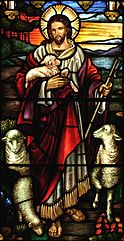
But putting aside that, one picture is literally an affront to the other.  A depiction of Muhammad is, essentially, also creating a graven image of a false idol under scripture of the bible.  Similarly, painting Jesus in stained glass is clearly an offensive front to any follower of Islam, as that would clearly make one an infidel, apostate, or blasphemer - implying some other god exists. 

This leads me more directly to the point: anything that goes against what you believe can be offensive.  PETA, for example, have done some good work in uncovering a few instances of negligence and abuse, but also routinely kill animals at their own no-kill shelters. 

This is exactly the same sort of thing the Charlie Hebdo comic was discussing, the disproportionate acts of those in power in Islamic countries to those who simply disagree with them.

This image of the leader of ISIS wishing people good health.  This is the image that supposedly sparked the attack on Charlie Hebdo.  If this is offensive, then every other image in this article is also.  Should all political cartoonists have to worry about violence because they talk about things that make people uncomfortable?  No.  Are people justified to act out in violence because they are offended?  Again, no. 

We are Charlie Hebdo.  We all have a right to express our disdain for things.  We all have a right to poke fun now and again.  We all have a right to make people uncomfortable.  We don't have a right to be violent, however.  We don't have a right to simply kill people we disagree with. 

Then again, there's a third, even more subtle point here: we are all human.  Why must we subdivide?  Would this be less offensive if it were Kim-Jong-Un (wishing everyone a happy new year, including his 200k or so enslaved citizens)?  Would it suddenly be more acceptable?  What if it were the pope (wishing well all those people he'd punch in the face for calling Jesus an etherial skydaddy), or maybe Charlie Manson (wishing his victims well from his prison cell)? Are those really more acceptable satires?  Are they any less offensive?